Monday. I wake at five when my trainer Sam knocks on the door. Today is what my husband calls “leg day”. We squat and swing kettlebells in our gym until I want to collapse and afterwards I meditate in the outdoor cedar sauna that my husband imported from Mississauga last winter. I don’t even want to name the price because it’s obscene.
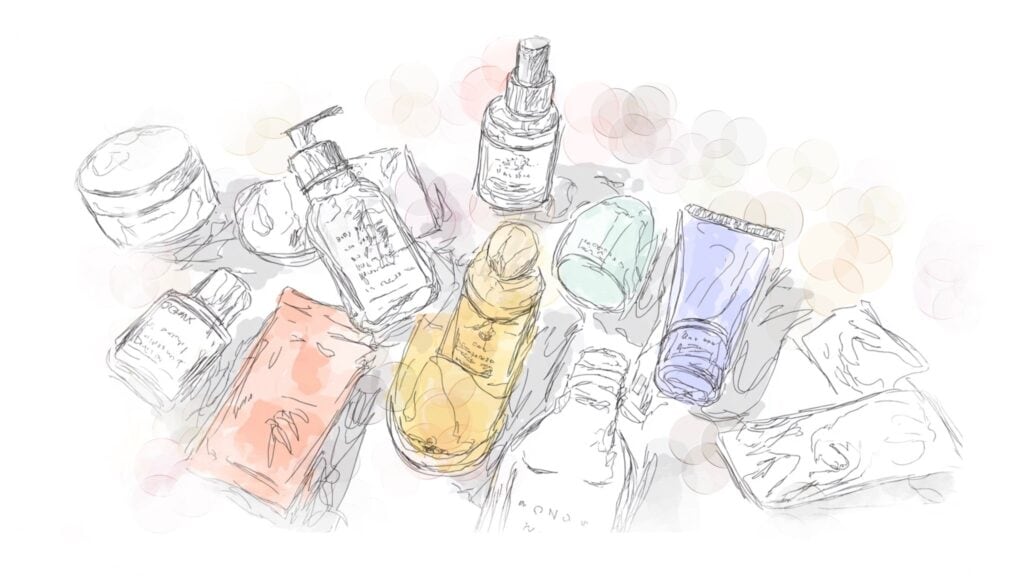
When I walk inside my children are eating breakfast with their nanny Lola, their eyes glued to their iPads. I first wash my face with the Biologique Recherché Lait VIP O2, which smells like spoiled milk, and then apply the Skinceuticals CE Ferulic serum, whichI recently started buying in bulk — one for myself after my son’s bed-wetting sleep regression left my skin dry and crusty-looking and another for my teenage daughter, whose distress at her first pimple warranted not one, but two visits to a very expensive out-of-network child psychologist. “I had breakouts at your age, Daisy, and I survived,” I told her, to which she replied, “Yeah, but you were born before the internet was even invented.” My makeup is simple, just theClé de Peau Beauté Concealer SPF 27 and the Diorshow Iconic Overcurl Mascara in 090 Black.
I kiss my children goodbye and step into my waiting car. My dermatologist, Dr. Otto Puppenspieler, calls to ask if the 440 units of Botox he injected last week had taken satisfactorily. We did forehead, elevens, brows, crow’s feet, bunny lines, traps, DAOs, masseters, nostrils, jowls, tech lines — which does mean needles in your neck — and a lip flip.
“Please don’t forget our appointment tonight,” he says before I hang up. “Biweekly. I have a no-tolerance policy for no-shows.” I check my calendar and there it is — Dr. Puppenspieler, 5 E. 66th St. I text my assistant Meggy and ask her to be better about reminding me about these things ahead of time.
About Dr. Puppenspieler. I cannot in good faith recommend him because he is impossible to book. ****** ******, a famous actress, who is also a mom at my son’s school, referred me. She cornered me at drop-off one morning to set up a playdate because she had heard about my son’s dyslexia and thought that her son, who is rather plain-looking and shy, might enjoy befriending another boy who is also, in her words, flying his kite against the winds of popularity. It was over coffee one morning while our sons played in her brownstone’s backyard that has, get this– fruit-bearing trees. In Cobble Hill ! — that she told me about the very tasteful work she had recently done. “He’ll shave twenty years off your face,” she said. “But he’s very particular with who he takes on as a client. I’ll tell him you’re a friend.” I trusted her because she has very expressive eyes and talks like everything she says is a secret.
I stop for a pistachio-milk latte and get to the office by 8:30. I spend the first hour of my day catching up on emails and reading the news — WSJ, FT, HEMLOC, and Bloomberg. I keep the Prada Beauty Hydrating Lip Balm ($50 — I’m so sorry) at my desk and reapply like a tic. I’ve been at Brimstone for eleven years. I was promoted to senior managing director the day that I found out I was pregnant with my son and returned four weeks after he was born, still wearing diapers (Frida Mom Boyshort Disposable Postpartum Underwear).
I walk into my boss’ office and his face is cold and tight. He tells me that he has promoted Jennifer to partner. Jennifer is ten years younger than me and barely qualified to be an MBA associate, let alone managing director, let alone partner. “Did you fuck her?” I ask, which makes him laugh. I smile wide and feel my teeth slicing through my gums.
Back in my office (soundproofed) I scream and scream and kick over a trash can. I watch the dry-cleaning tags fall to the floor like snow and then I reapply my mascara, Diorshow Iconic Overcurl Mascara in 090 Black. I can’t stand to look at Jennifer and my hapless analysts so I leave early for my Platelet-Rich Plasma Facial with Stem Cell Therapy — it’s ethical — with Dr. Puppenspieler. His office is surrounded by floor-to-ceiling windows and the glass is so clean it seems like you could walk right through it and onto the street below.
A glossy nurse walks me into the treatment room, which smells like a Diptyque Ambre candle. “You here for Dr. Puppenspieler?” she asks, smacking her hot pink gum. I put my feet in the stirrups while she takes vial after vial of blood. My vision goes slack then doubles as I watch it spin around and around in the centrifuge.
Dr. Puppenspieler walks in and lines up dozens of tiny needles on a silver tray, talking while he wipes my face with a cold alcohol wipe.
“There will be blood, yes, lots of it. I hope you don’t faint, most women don’t, especially mothers, but the men you wouldn’t believe. Fainters, all of them! You got kids?”
I tell him that I have a daughter and a son.
“Good, good,” he says. “If you do faint, don’t worry. I have defibrillators in every room.” I look around and indeed there are defibrillators alert and waiting in the corner of the office.
“You won’t believe how good your skin will look after this,” he says, “like a teenage girl’s, so full of collagen, you’ll hate your own daughter because her skin just does this naturally. Of course, time will catch up to her as well. Now, hold still.”
He injects my plasma in staccato bursts across my face, neck, and chest. When he’s done my skin is as red as a field of poppies. He turns my head around in his hands and tells me that a few more millimeters of lift would make a world of difference.
“The world opens up when the face does, my pet, I have always said this, it’s why I prefer those with flatter faces. Ms. ****** was a Choate lacrosse goalie, I knew the second she walked in. Flatter faces, you see, they perceive more of the world’s sublingual messages.” Do you mean subliminal? I ask, and he ignores me.
“Three millimeters,” he says, “will make all the difference. I’m going to book you for next weekend. Your husband won’t even notice the sutures unless he knows your face very, very well. Invented the technique myself.”
Who am I to argue with three millimeters? I pay for the facial at the front desk ($2,150) and the glossy nurse schedules me for an Upper Blepharoplasty with General Facial Reconstruction per the Doctor’s Discretion ($103,000). I’m supposed to be skiing in Sun Valley with our investors next weekend, but I suppose Jennifer, whose face doesn’t yet show all of life’s little disappointments, and certainly not melasma, is now attending in my place.
I email Meggy and ask her to book me three nights at the Carlyle and to pay in cash. I find a bar nearby, even though Dr. Puppenspieler forbids alcohol, and order a ginmartini, straight up with a twist. I down it it in three big sips and then I order another. I text my old dealer, still saved in my phone as Angelo Snow ❄️. My pleas return undelivered and green.
When I get home my daughter is still awake, finishing an essay on Othello. “They have you reading Shakespeare already?” I ask, and Daisy says, “yeah, but I preferred Lolita. It was way creepier.” She’s beautiful like her father, with full lips and big eyes and a teeny-tiny chin. I remember reading once that women are attracted to men their own age, but all men are most attracted to 20 year-old women. You know what I think? They’d fuck a teenager if they could get away with it. Fucking pervs. We eat popcorn together over the sink and then I send her to bed.
When the house finally quiets, I tiptoe to the bathroom. I wash my face with the Biologique Recherché Lait VIP O2 twice, scrubbing for seven or eight minutes straight, and then I apply layer after layer of topical anesthetic before I begin the lasers, which Dr. Puppenspieler recommends for professional-grade dermal resurfacing: the Fraxel® FTX Laser Resurfacing System, the Rejuran®RF Microneedling device, which uses salmon DNA to regenerate lost collagen, and another called Der Geist 4, which Dr. Puppenspieler flies in from Korea.
All I will say is that the lasers are not as painful as childbirth.
I slather on Crème de la Mer Moisturizer anda Fetal Colostrum and Placental Stem-Cell Night Cream that Dr. Puppenspieler sells in his office and finally, the Rhode Peptide Lip Tint in Watermelon Slice, which I stole from my daughter.
In the mirror I notice the edges of my body fading away, like static on TV. It’s subtle. Three millimeters, max. I lift my hand up to inspect, admiring the way the light filters through my shimmering fingers. It’s beautiful. Weightless.
I slide into bed next to my sleeping husband and I dream all the way to morning.
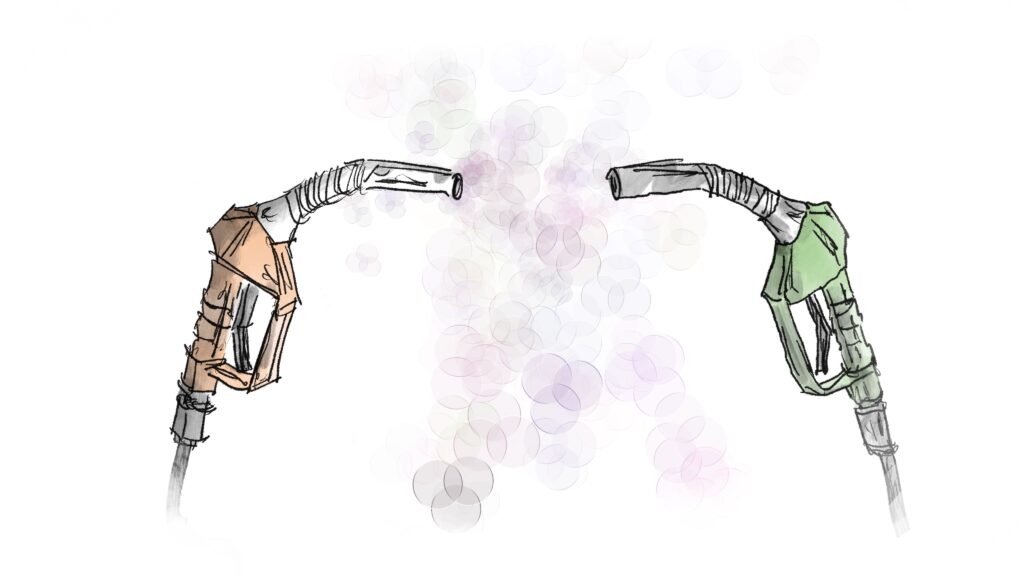
The sun rises above a desert mountain range. Its golden glow banishes the shadows in front of two gas stations paralleling a lonely freeway.
A man, still clinging to the horseshoe head of hair he has left, stoops under the empty garage door of one of the stations. He straightens up and breathes in the fresh morning air.
A rusty red pickup truck and a white van approach from the distance.
The balding man follows their progress. As the vehicles approach, he passes his tongue over a chapped upper lip and flashes a yellow-tinged megawatt smile.
Both vehicles turn into the gas station across the street. The man’s smile disappears quicker than shadows in sunlight. He looks at his gas prices and glances at the station across the street. They are three cents lower than his. With a slump of the shoulders, the balding man retreats to his garage.
…
A man with a thick handlebar mustache limps out of a small snack shop attached to the gas station across the freeway. He looks at his two unoccupied pumps and then glances up and down the road. He sighs and leans back against the station wall.
A truck engine’s roar prompts the mustachioed man to take a staggered step forward.
The mustachioed man gives a friendly wave to an oncoming truck, but the truck ignores the welcoming gesture and turns into the station across the street.
The man’s hand falls limply to his side. His neighbor’s freshly cleaned gas price display sparkles in the sunlight. It reads five cents cheaper than his prices.
Across the street, his balding neighbor’s yellow smile flashes. The mustachioed man limps back to his garage.
…
The balding man takes a rag from his back pocket and wipes the top of his head. He smiles at the red pickup and the white van returning from their journeys and watches them drive back toward the mountains. A shuffle and clang from across the street divert his attention.
His neighbor limps toward his gas price display, holding a ladder. The neighbor gives him a feeble wave, and the balding man answers the gesture with a wavering smile.
…
The mustachioed man pulls his wool-lined coat tight with one hand and grips a clipboard with the other. He limps across the deserted nighttime highway. A lone bulb from his neighbor’s garage casts a dimmed light outside the station.
…
The balding man slumps at a desk, staring at a gas price ledger with red-rimmed eyes. At the sound of a shuffle, he cranes his neck toward the garage entrance and notices the clipboard in his neighbor’s hand.
Their eyes meet. The balding man stands up as the mustachioed man limps over. They each raise a hand and grasp the other’s in a warm embrace.
…
The sun rises in the valley, banishing the last tendrils of nighttime from the front of the stations. The balding man and the mustachioed man wave at each other. Their gas prices are identical, ten cents higher than they first were the previous day.
In the distance, the red pickup and the white van approach, slowing down as they reach the stations.
Both vehicles stop in the middle of the road. The mustachioed man and the balding man step forward with a friendly wave toward the vehicles.
The pickup turns into the balding man’s station, and the van turns into the mustachioed man’s station. Each man steps forward with a smile to attend to their respective customer.
As the men approach, the red pickup and the white van rev their engines.
Your handshake… Was it too tight? Your dad would say so. It was clammy. Salt-watery. Don’t think too much about the handshake— even if it wasn’t really a handshake since you were grabbing his limp flipper too tightly. You need this job. And not everyone gets past this point.
He’s wearing a suit, the manatee. It’s tailored around his fat, gray neck. His tie’s got little embroidered clam shells. White mollusks on blue backing. Blue — it’s a power color. Strong, like hurricane waves or riptide. Like executives with leathery gray skin.
You know you shouldn’t have worn the red tie today. You had a choice and it was the wrong one. He looks at your chest when he begins, hesitantly,
“This is your… Third round interview so far.”
You don’t reply. You sit on the chair in front of his desk. It’s moist. There’s a clump of seaweed attached to one of the legs. It reeks of brine.
Three rounds of interview. Of only two, the recruiter had lied. But not everyone can get an entry-level role doing front-end testing at a mid-level West Coast SaaS startup (with benefits). They may get past the online interviews, but that’s only because most people are allowed to get this far, the manatee. But not everyone gets past the manatee. Will you? The thought makes you want to vomit blood.
He smiles with big bulbous jowls. “Shelley and her team were happy to pass on feedback when you spoke with them last month. Her, ‘pod,’ so to speak,” he adds.
You don’t know who Shelley is. She’s a name on letterhead that you followed up with exactly four hours after the cessation of your interview two months ago, but beyond that, she doesn’t exist. You don’t want her to exist. You just want a job. And so you nod, affirming the manatee.
“It was nice to meet her team,” you say. “Or, ‘pod.’”
He frowns. You’re not allowed to use that word in a professional environment like this. You should have known better. The manatee looks at something on his laptop. It churns, like it’s a boat’s propeller, about to rip off and scar you and the manatee both.
He swallows. Gurgles, more like. A blowhole discharges but he doesn’t look embarrassed, no, because it’s a powerful action for an executive.
“I took a look at some of the exercises you completed,” he says.
You don’t remember them, the exercises. They may have been logarithmic problems or calisthenics. That was four months ago. When you were just as poor. You’ve been living with a woman twice your age since then. You met her online and she owns an apartment in the city and you need a bed and somewhere to store your massive collection of stupid, stupid red ties. She looks like the woman on the manatee’s desk, in a photo. The woman’s got her arm around the manatee.
In that picture, he has things you don’t. Sunglasses. Margaritas, in both fins. A blue-white Hawaiian shirt unbuttoned to his mid-chest. An income.
The manatee laughs. A bellow sort of laugh. It goes on too long, as if he were hit with a yacht. You notice the batch of coral on his desk, all sharp. He’s got pens sticking out of the little holes at odd angles. And a Top Sales award next to it.
“Your resume is impressive,” he says. “Do you have any questions on the role?”
How is a manatee sitting at a desk?
But that’s an asinine question to ask in a job interview. He’s got a massive, flapping, wet tail and an income and not everyone can have both of those — maybe one, but not usually both, not in this economy.
“What is the most challenging blocker your team resolves on a daily basis?” you croak.
“Great question,” he lies. He talks at you but looks at the poster of kelp on the wall, avoiding eye contact. That’s a bad sign. You lean forward and smile. You try to win back the manatee but it feels like an inhuman task, winning the approval of an underwater mammal in exchange for income. Makes you nauseous.
Ten minutes ago you were in the handicap stall across from the women’s restroom, vomiting into the toilet between hits of your vape cart. Something in the bowl was red. Like your tie, the blood, red. It’s a power color, you coped. Powerful, like your haircut that your father recommended, as the manatee doesn’t respect long hair. And not everyone gets past the manatee, do they?
The manatee looks at you. He squints and smiles with fleshy black lips. He studies you. Whiskers twitch and a bead of slobbery moisture drips onto his desk. He finally asks, as if he doesn’t know, “What makes this role attractive for you?”
Food, you want to say. Kelp, to be relatable. And those are terrible answers. The truth: you want to swim free. Like him, you want to follow the warm water channels along the Gulf Stream and cozy into inlets and migrate with the ones you love — and you can’t do that without an income. So for now you need an office with air conditioning and a copier with salt dried on top of touchscreens. You need the job and for that you need the manatee’s respect and love and mercy. But you can’t say that in a job interview.
It’s too much. You say something else. But it’s not like what you say is memorable or important enough to get anything more than a smile.
He nods. At your exit, he declines to rise. If he could, if he didn’t have a massive meaty tail under that desk, he wouldn’t, anyway. He just hands you a limp flipper and brays, “You’ll be hearing from our team soon.”
That’s a saltwater lie. Your handshake is wet and your tie is red. And you know, deep down, you’re not going to make it past the manatee.


Reader Comments
Loved this piece, would love to know more about this character! Very well written.